MIT invests up to a billion dollars a year in fossil fuel companies that destroy our planet.
If that sounds wrong to you, then tell President Reif to


We're calling on MIT to divest from fossil fuels. Our school currently invests hundreds of millions of dollars from its endowment in fossil fuel companies like Exxon and BP. We want MIT to stop making new investments in these companies and, over the next five years, eliminate all such investments. Here are four compelling arguments for this strategy:
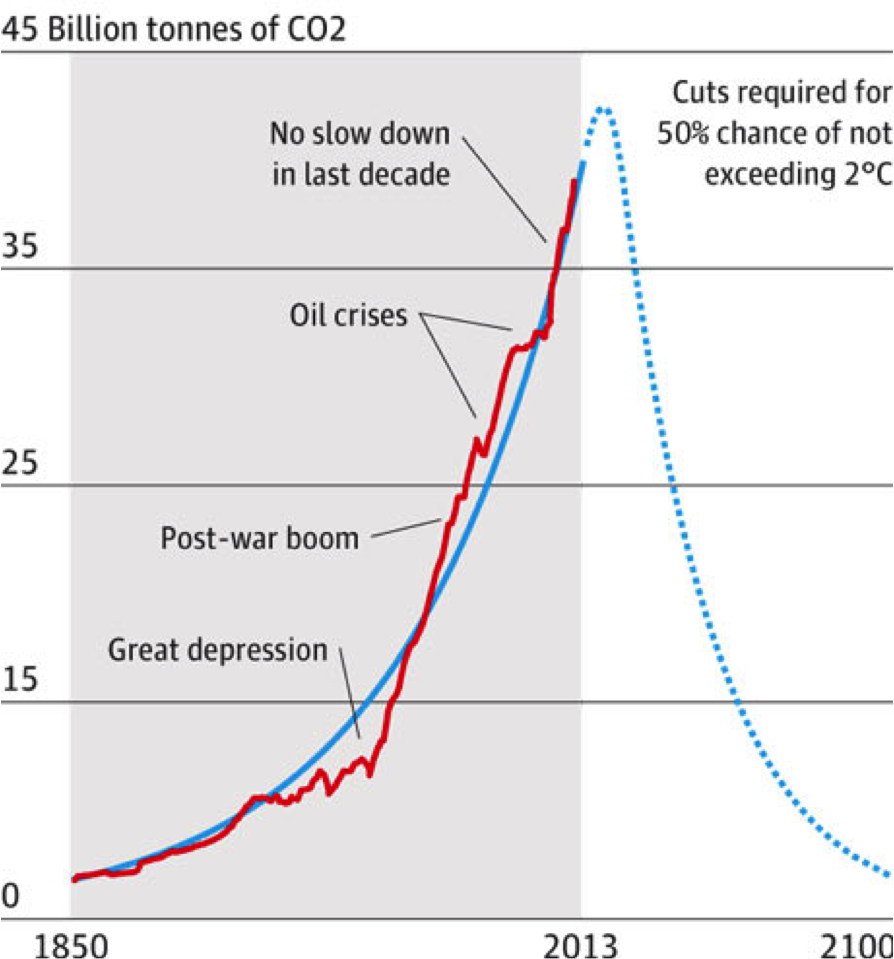
Ever since the Industrial Revolution, mankind's CO2 emissions have rocketed at a constant, unremitting exponential rate. To stay below the 2C guardrail, we have to get off the curve.
The most advanced climate models in the world tell us that to avoid 2C, our CO2 emissions must peak in the next decade and then fall at the same rate they've been rising for two centuries. That's the ball game.
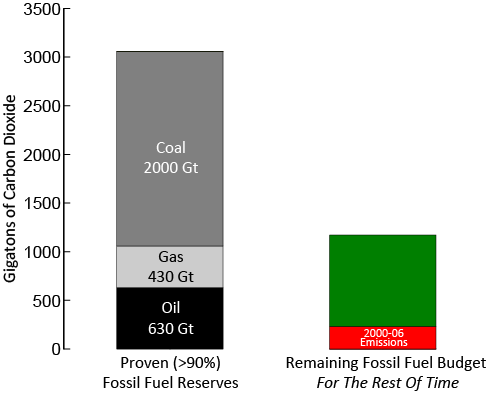
Our CO2 emissions must fall so rapidly because there's only so much CO2 we can afford to emit for the rest of time – there's a budget on CO2 emissions, and therefore on fossil fuel burning. The terrifying math of global warming is that we have at least three times more fossil fuel reserves than our budget allows, and we intend to burn it all. We have more than we can afford to burn.
These fossil fuels are technically in the soil, but already economically aboveground. They are the fossil fuel companies' primary asset, the holding that gives the companies value. They are figured into share prices and fossil fuel companies are borrowing money against it. Little wonder fossil fuel companies lobby so hard against climate change action, or even the reality of global warming.
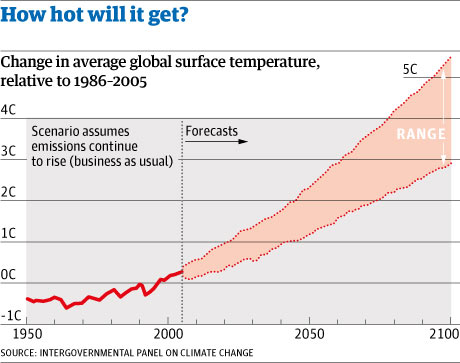
At the current rate of fossil fuel burning, we will exceed our fossil fuel budget in about 10 years, and pass the 2C guardrail in 30 years. We have more than we can afford to burn. But we just keep digging. MIT is investing in this digging. MIT is funding global warming. Tell MIT to divest from fossil fuel companies.
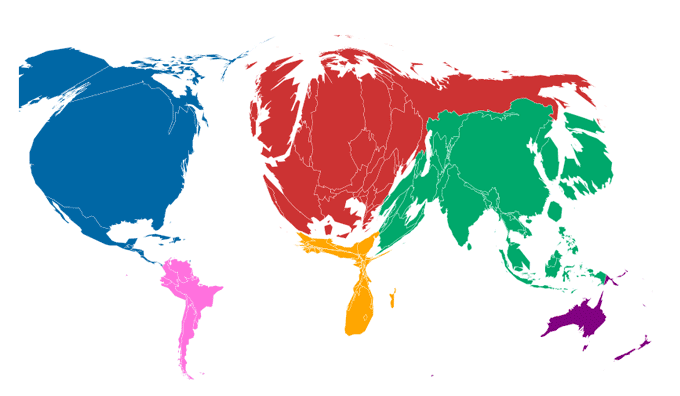
This is a map of the world inflated to reflect fossil fuel usage...
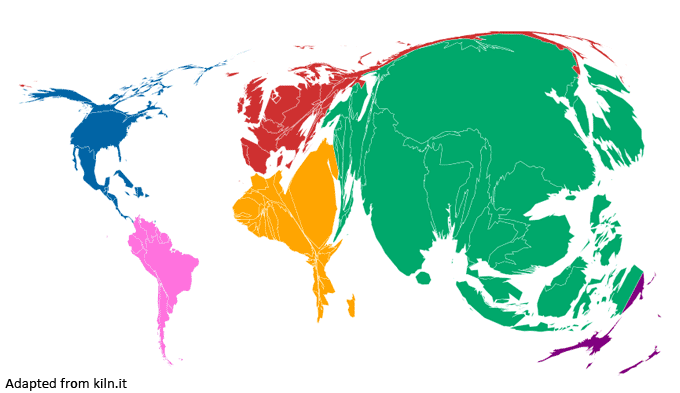
And this is a map inflated to reflect vulnerability to global warming.
Surely it is immoral and hypocritical of MIT – an institution at the cutting edge of climate science and renewable energy – to be investing in the fossil fuel industry, the root cause of global warming?
MIT is a global leader and we wield a megaphone to public opinion. Through divestment we have an opportunity to symbolically strip fossil fuel companies of their 'social license' and loosen their stranglehold on Washington.
We must protect our moral authority by doing what's right. Tell MIT to stop funding global warming. Tell MIT to divest from fossil fuel companies.
"Those who have the privilege to know have the duty to act" — Albert Einsten
...And here at MIT, we know an awful lot.
We already have the technological solutions to climate change, many developed right here at MIT. What we're lacking is political will.
We have a moral imperative to demand bold political action. We need an end to fossil fuel subsidies, lobbying and public disinformation. We need a price on carbon. And we need revolutionary commitments to renewable energy. We need a commitment equal to this unparalleled moment of opportunity to save our planet.
Through MIT we wield a megaphone to public opinion. We can shift debate at the highest levels.

To keep below 2°C of global warming,
60 - 80% of fossil fuel reserves of listed firms are unburnable. There is more fossil fuel listed on the world's capital markets than can be burned.
If we are to save our planet from climate change, we have to write off $20 trillion of stranded fossil fuel assets. The housing bubble could be small compared to the carbon bubble now looming.
To keep global warming below 2°C, HSBC warns that equity valuations could be reduced by 40 – 60%. Investing in fossil fuel companies heavily reliant on constantly replenishing reserves of fossil fuels is becoming a very risky decision.
And MIT is taking that risk with your money – with MIT's $11 billion endowment. What does that mean for the long-term security of MIT's endowment?
MIT's continued investment in fossil fuel companies reflects a myopic, short-term market assessment, and jeopardizes the Corporation's fiduciary duty to protect the endowment's longevity.
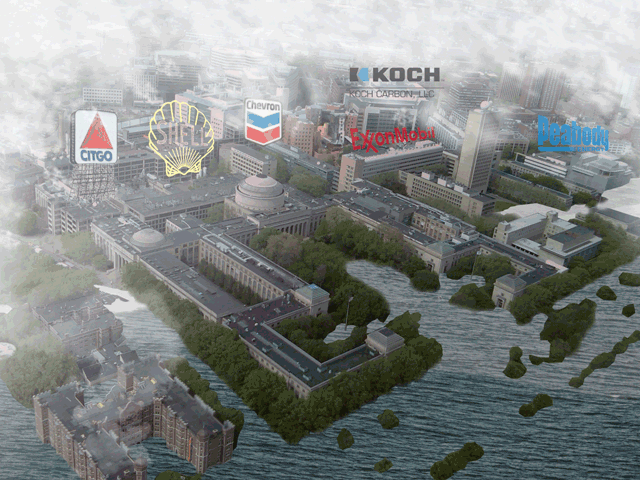
Our beloved institution, the one that prides itself on using mind and hand for the betterment of humankind, lies silent, ghostly, watery. It’s the year 2050, and climate change has made no exception for MIT as it’s ravaged the world. We contributed extensively to both the understanding of the warming problem and the engineering, policy, and planning solutions to prevent it from reaching a critical tipping point. But that consensus, scientists practically pleading with the forces at large about climate change’s urgency, had not been sufficiently heard. The alternatives available had been noted, their innovation applauded, but not deployed while the window was still open. When a storm the size of Sandy hit Boston, it coupled with about 2.5 feet of sea level rise. The drainage allowed by the Charles met its match.
The three miles of blue tape wrapping around the central buildings of MIT’s campus represent where the water lies.
Without action to combat climate change, if a Superstorm like Sandy strikes Boston again anytime after 2050, MIT will most likely be under up to six feet of water. The Blue Line indicates the projected floodwater height from a Sandy-like storm, compounded by global warming-induced sea level rise. The heights of the Blue Line are based on a report from The Boston Harbor Association (TBHA), co-authored by MIT alum Prof. Paul Kirshen ('Preparing for the Rising Tide', 2/2013).
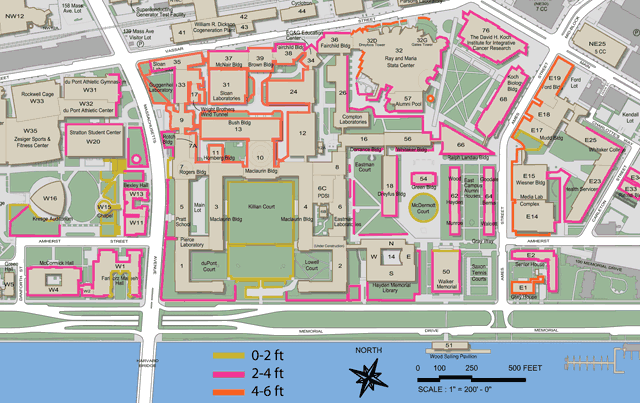
Over the next 40 years, raised sea levels arising from global warming, combined with a 5ft storm surge (as it was with Sandy) and Boston's 5ft high-tide, may lead to flood levels surpassing the Charles River Dam, flooding MIT. Specifically, the Blue Line represents the flood depths shown in Fig. 9 of the TBHA report, with an error of plus-or-minus one foot.

The petition calls on MIT to halt further investments in fossil fuel companies and to divest its current holdings in these companies within five years.
This petition is part of an international climate change divestment movement spanning more than 300 universities and 100 cities. Divestment commitments have already been made by 18 cities including Seattle, San Francisco, Portland, Berkeley, and our very own, Cambridge, MA.
The petition calls on MIT to divest its $11 billion endowment from the top 200 fossil fuel companies. Despite the closing window of opportunity – about 15 years – to prevent irreversible and dangerous global warming, MIT will only consider halting its investments in the industry at the root cause of this crisis if the MIT community demands it. So we need your help. Please consider signing our petition.
The 200 Companies
Which companies? We are urging MIT to divest from the 200 fossil fuel companies possessing the largest fossil fuel reserves in the world (measured in terms of their potential carbon emissions), as identified by The Carbon Tracker Initiative and the Grantham Research Institute at the London School of Economics. A complete list is available here.
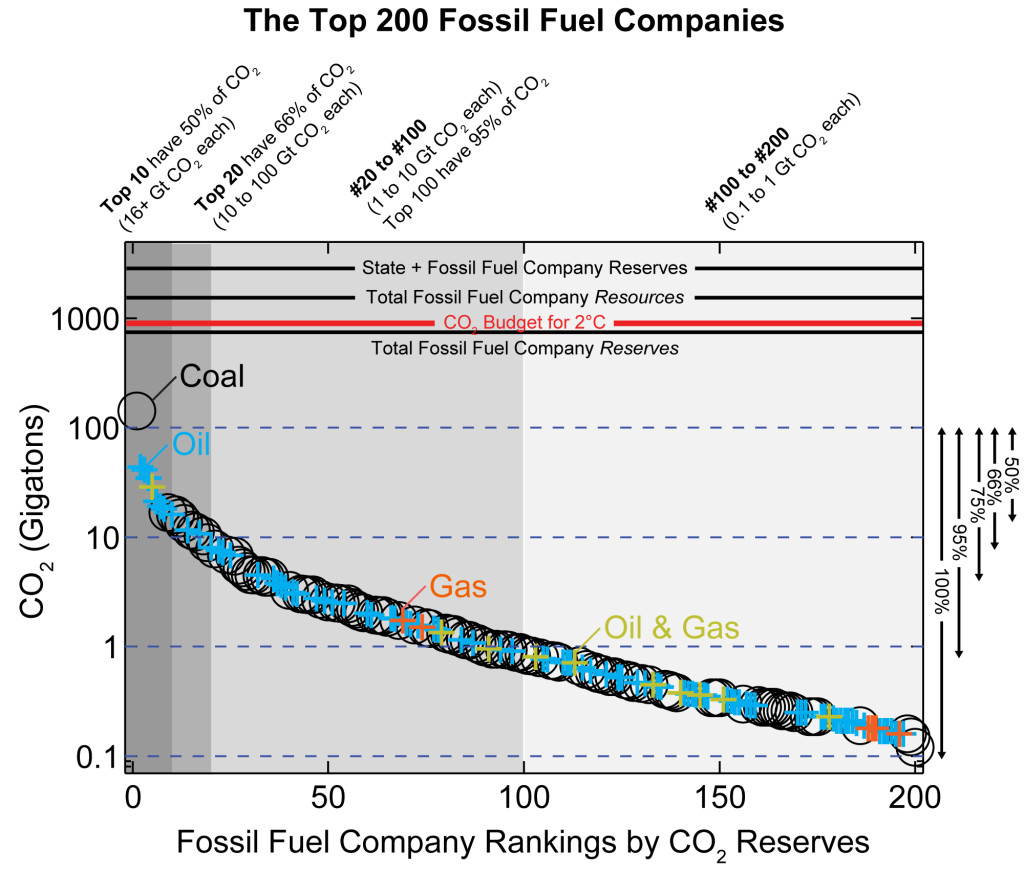
At MIT we like graphs. The graph above plots the carbon dioxide reserves of each of these 200 companies, ranked in order of their share. The data are plotted on a semi-logarithmic scale, which means that the distribution of reserves between companies is exponential. The significance of this is that most of the carbon is in the hands of a few:
- the top ranked company (Severstal JSC) possesses 20% of the reserves all by itself!
- the top 10 companies possess 50% of the reserves
By divesting from just a handful of the highest-ranked companies, we can:
- Dramatically reduce the carbon burden of MIT's endowment and, accordingly, MIT's financial and social contribution to climate change.
- Show the world that science and courage trump politics and greed.
- Protect MIT's moral authority by doing what's right.
- Symbolically strip fossil fuel companies of their 'social license' and loosen their stranglehold on Washington.
- Use MIT's megaphone to public opinion to demand bold climate change action and to shift the debate.
- Protect the longevity of MIT's endowment for future generations by avoiding a $20 trillion carbon bubble.
Yes! I call upon MIT to immediately freeze all investments in fossil fuel corporations, and to divest all its fossil fuel holdings over the next five years.